
Fitness pros and weight-room buffs alike dismiss thesit-upas ineffective and pointless. Pretty much everyone, even those who don't hit the gym regularly, has probably heard there are so manybetter exercises for your abs。
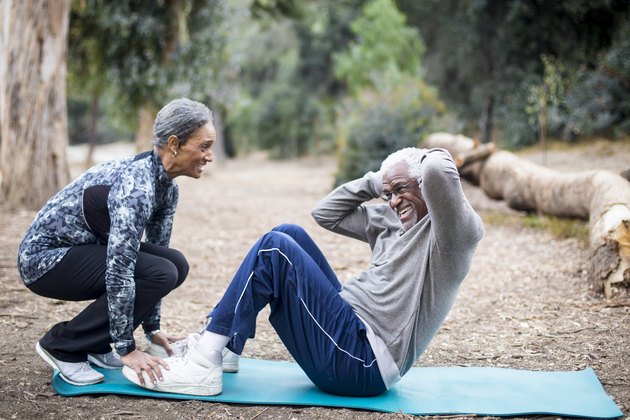
Brian Jimenez, fitness coach and certified stretch therapist at拉伸救援, tells LIVESTRONG.com that sit-ups "unfortunately and justifiably get a bad rap" because the move has little to do with actualcore endurance, strength, stability or mobility.
"Traditionally, the movement is usually done for high repetitions and speed," Jimenez explains, noting that this can lead to poor technique and thusinjury。
Sit-ups aren't all bad, though — like all exercises, what matters most is your form.
When performed correctly, sit-ups do offer some functionality and can helpimprove your core strength, says Caley Crawford, CPT and director of education atRow House。But when performed poorly, you risk hurting your spine without much payoff in terms of strength or other fitness improvements.
The Benefits
1. Sit-Ups Can Improve Core Strength
If you're going to do sit-ups, it'simportant that your form is correct, says Pamela Kalechofsky, certified stretch therapist at拉伸救援。这意味着她有用的指针:
- Lie on your back and lock your feet under a bench or other low space, or work with a partner to hold your feet.
- Be sure you're fully warmed up and that your core is engaged so you don't strain your back as you raise your torso off the ground with your hands on the sides of or behind your neck.
- Never pull on your neck, crane your neck or tuck your chin, which creates pressure on your cervical spine.
- 当你降低你的身体回到起始位置,躺下全部背下来之前,去为另一个代表,释放你的肌肉的方式。
When performed with flawless technique, sit-ups can be part of a well-rounded core workout, but they aren't the most effective exercise forimproving core strength。
Core stabilization exercises, which target the core muscles without placing any load on the spine, are more effective, according to an older randomized controlled trial published in December 2009 inMedicine and Science in Sports and Exercise。
2. Sit-Ups Translate to Everyday Movement
Crawford, who includes sit-ups in her own fitness regimen and her group fitness classes, says she does so because sit-ups translate to something we all do every day, sometimes multiple times a day: sitting up.
每一个one needs to know how to get up from a lying position without injuring themselves, and sit-ups are a good way to learn or refine that skill when done with good form.
A common form mishap Crawford sees is flailing the arms back and forth to gain momentum. "If you must use your arms to get up and down in a sit-up, it likely means you're not ready for them yet," she says. "My belief is that if you can't do a movement slowly, you probably shouldn't do it fast."
Tip
To make sit-ups more comfortable, try performing them on a thick mat or towel or even astability ball, which supports the natural curve of your spine and protects it from excessive pressure.
The Drawbacks
1. Sit-Ups Can Lead to Injury When Performed Incorrectly
Part of the reason why sit-ups have a bad reputation is because of the emphasis on spinal flexion, or bending or hunching forward. Excessive spinal flexion is known to put stress on the spine and causeback injuries, Kalechofksy says.
This is partially because sit-ups actually target yourhip flexors— the muscles that flex your hip, including your quads — more than your abdominal muscles, according to theAmerican Council on Exercise。Because your hip flexors attach to the front side of your lumbar spine, they can tug on your spine if they become too overworked or tight, which can lead to lower back pain and eventually injury.
2. Sit-Ups Can Reinforce Bad Posture
If you're performing sit-ups with poor technique, there's a chance it'll follow you outside of the gym. When you exercise, you should be trying to offset the poor posture you may have all day from sitting at a desk or lounging around, not continuing to reinforce bad habits.
You don't want to "practice" postural mistakes like craning your neck or tilting your hips in life or in your ab workouts.
Related Reading
3. Sit-Ups Tend to Be an 'Ego Exercise'
Jimenez says the first thing you need to check before doing sit-ups is your ego. If that sounds harsh, it's just because sit-ups tend to be an "ego exercise," or one that people associate with competitions and feel the need to over-perform. Having flashbacks to middle school gym class assessments? You're probably not the only one.
"Ego can play a very important role in how one goes about the intensity [of sit-ups], so it's pertinent to check that first," Jimenez says, noting that many people rush sit-ups in an attempt to crank out as many reps as possible in a short timeframe.
进行仰卧起坐时,节奏和两个偏心阶段(向下的方式)和同心阶段(达路)控制是至关重要的,克劳福德说。
"In all core work, control and tempo are key, and good form is much more important than doing a lot of reps in less time," she explains. "It's not about how many reps you can do. It's about how well you do them."
The Verdict
Jimenez, Crawford and Kalechofsky all agree that sit-ups aren’t the best exercise for developing core strength, stability or mobility. While sit-ups have their benefits, they’re best for people who are already strong enough to support their spines and those who have to do sit-ups as part of a professional training regimen, such as active-duty military. “If you really love them, warm up properly, have a strong enough core to do them and execute them carefully,” Kalechofsky says.
Core Exercises That Are Better Than Sit-Ups
Don't fret if you're now at a loss for core exercises: There areplenty that can give you more bang for your buck!尝试这些中的一个,看看如果他们不给你更多的烧伤比仰卧起坐做。
Plank
The plank could be considered the holy grail of core exercises: Holding a plank teaches you to engage your core and keep your spine safe and it builds total-body strength.
- Lie face down with your palms on the floor next to your shoulders and your feet flexed with your toes on the floor.
- Take a deep breath and press up so your arms are straight. Your body should make a straight line from your heels to the top of your head.
- Draw your navel toward your spine and tighten your buttocks.
- Hold for at least 10 seconds.
To add even more spice to your planks, try these11 plank variations。
Bird Dog
Thebird dog exerciseis one of the most functional — but underutilized — core exercises out there.
- Begin on all fours, with your hands under your shoulders and your knees under your hips.
- Engage your core and extend your right leg behind you. Simultaneously extend your left arm in front of you, palm facing down.
- Return to all fours, keeping your core engaged and hips and shoulders steady the entire time.
- Repeat with the opposite arm and leg.
Compound Movements
Compound movements are exercises that work multiple muscle groups and flex more than one joint. Squats, deadlifts, push-ups, pull-ups, overhead presses,lungesandhip thrustersare all examples ofcompound movements that work your abs, even if they don't explicitly isolate your core.
Think about it: When youdeadlift, you engage your core to offset pressure from your spine and keep your spine from flexing or extending. When weighed down with a heavy barbell or dumbbells, that's some serious core work!