
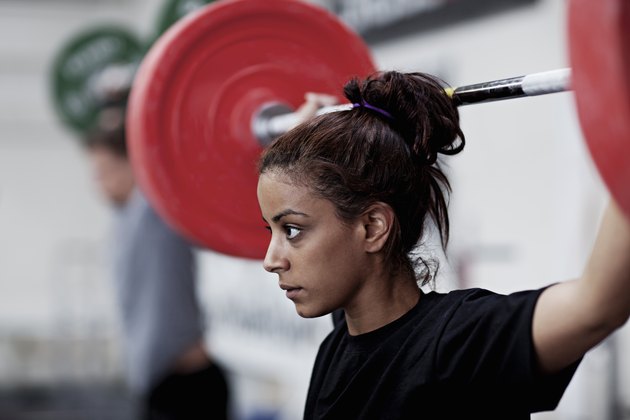
什么是典型的肌肉?Unfortunately the short answer is "It depends," because everyone's body responds to stimulus a little differently. But in general, the average exerciser can expect to gain about 3 pounds of muscle in two months of strength training.
Tip
Ultimately, every body responds at a different rate to the stimulus that promotes muscle growth. But as a general rule, the average adult adds about 3 pounds of muscle after two months of strength training.
How Muscle Growth Happens
If you've chosen muscle building as a fitness priority, it helps to understand how your bodyputs that extra muscle on— otherwise you might find yourself doing things that are actually counterproductive to your goals.
The nutshell version, drawn from a discussion by exercise physiologists with theUniversity of New Mexico,是强烈的运动(如抗性训练)导致肌肉纤维的次要创伤。这在肌肉纤维的外部激活卫星细胞,然后乘以和保险熔丝,形成新的肌肉纤维并修复旧肌肉纤维。
But this doesn't happen during your workout; it happens during the rest period after your workout. That's why a mindset of "More is always better" can be counterproductive when it comes to weight training. The truth is that more stimulus usually does provoke more results — but only if you also allow your muscles sufficient rest and recovery time in between bouts. Otherwise you're just repeatedly traumatizing them but leaving them no time to put themselves back together, in a very literal sense.
Your Rate of Muscle Gain
How can you quantify the amount of muscle that's gained — especially in the face of sometimes contradictory studies about exactly which methods provoke the most muscle growth?ExRx.netreports that, as a general gauge, an average adult adds about 3 pounds of muscle after two months of strength training.
But if you get less (or more) muscle gain than that, don't worry: You're not going crazy, and you're not necessarily doing anything wrong. As noted in a small study of 20 subjects, published in the April 2019 issue of theJournal of Strength and Conditioning Research,个体强度和肥大(肌肉生长)反应可以在相同的刺激下变化很大。
Of course, retained water, hormonal changes, shifts in body fat and even what you had for breakfast can affect your weight on the scale — so weighing yourself isn't always the best way to measure how your muscles have grown.
On the simplistic side of things, tracking how much weight you're able to lift can give you a relative idea of your muscle gains. Although the relationship between muscle strength and muscle size is a little different for everybody, increasedmuscular strength almost always correlatesto some degree of increased muscle size too.
A pound of muscle takes up less space on your body than a pound of fat, so even if the scale doesn't budge, tracking how your clothes fit can also give you an idea of how your body composition is shifting from adipose (fatty) tissue to muscle.
But if you're really serious about tracking your rate of muscle gain, the best item in your home arsenal is a flexible measuring tape. Whip that puppy out and start measuring the circumference of whichever muscles you want to track — for example, your upper arms or your thighs — at set points in relation to anatomical markers such as the crest of your hipbone or the point of your elbow and the bump at the top of your shoulder.
Write those measurements down, and then recheck them periodically, making sure you always measure at the same point in relation to those markers.
Read more:How Fast Can I Build Bigger Legs?
Tips for Muscle Growth
If you want to pack on more muscle, there are a few things you can do. One of the first is to add more sets: According to a systematic review published in the June 2017 issue of theJournal of Sports Sciences,有一个明确的剂量-response between the number of resistance-training sets you do in a week and the rate of muscle gain in the trained body part(s). In other words, the more sets you do with a given muscle, the more that muscle will grow.
Adding additional workouts for the week can help too. In a meta-analysis published in the November 2016 issue of the New Zealand journalSports Medicine, researchers placed the ideal strength-training frequency at one to three times each week per muscle group, and noted that strength-training twice a week yielded notably more gains in muscle size than doing so once a week. However, they note that there is not as yet, clear proof of whether strength training three times a week is more effective than twice a week for muscle gains.
You still need to allow each muscle group at least 48 hours of rest time between intense workouts. And finally, make sure you introduce any increases in workout frequency or intensity gradually, so that your body has a chance to adapt to the new challenges you're presenting it with. Doing too much, too fast often leads to injury, and that's guaranteed to set back your muscle-building journey.
Muscle Building Through Nutrition
只需击中健身房就不足以构建更大的肌肉。您的身体也需要良好的营养素 - 特别是蛋白质 - 用于产生新的肌肉组织。想到运动营养,好像你要求孩子用塑料块建造塔,但你实际上并没有给他们街区。交换不会很好地结束,你当然不会得到你想要的塔。以一种类似的方式,通过给予身体结果的唯一方法是使其成为组装新肌肉的适当材料。
Of course, scratch a dozen nutritionists and you'll get at least a handful of different approaches to how much protein you need. One of the most authoritative guidelines possible comes from the International Society of Sports Nutrition — in the June 2017 issue of the Society'sJournal of the International Society of Sports Nutrition, it notes that for most individuals, adaily protein intakeof 1.4 to 2.0 grams of protein per kilogram of body weight is enough to maintain and build muscle mass.
Nutrition labels list macronutrients such as protein in grams, but if you're in the U.S. you probably think of your weight in terms of pounds. That works out to 1.4 to 2.0 grams of protein per every 2.2 pounds of body weight; for most people, the math is much easier if you just convert your body weight to kilograms. For a rough and ready conversion, divide your weight in pounds by 2.2 to get your weight in kilograms.
So, for example, if you weigh 150 pounds, that works out to 150 ÷ 2.2 = 68.2 kilograms. So your ideal protein intake would be between 1.4 × 68.2 = 95.5 grams per day (a low limit) and 2.0 × 68.2 = 136.4 grams per day (a high limit).
And if you weigh 200 pounds, that works out to 200 ÷ 2.2 = 90.9 kilograms. Your ideal protein intake would be between 1.4 × 90.9 = 127.3 grams per day (a low limit) and 2.0 × 90.9 = 181.8 grams per day (a high limit).
- ExRx.net: "Toning With Weights"
- University of New Mexico: "How Do Muscles Grow?"
- Sports Medicine: "Effects of Resistance Training Frequency on Measures of Muscle Hypertrophy: A Systematic Review and Meta-Analysis"
- Journal of the International Society of Sports Nutrition: "International Society of Sports Nutrition Position Stand: Protein and Exercise"
- Journal of Sports Sciences: "Dose-Response Relationship Between Weekly Resistance Training Volume and Increases in Muscle Mass: A Systematic Review and Meta-Analysis"
- Journal of Strength and Conditioning Research: "Individual Muscle Hypertrophy and Strength Responses to High vs. Low Resistance Training Frequencies"