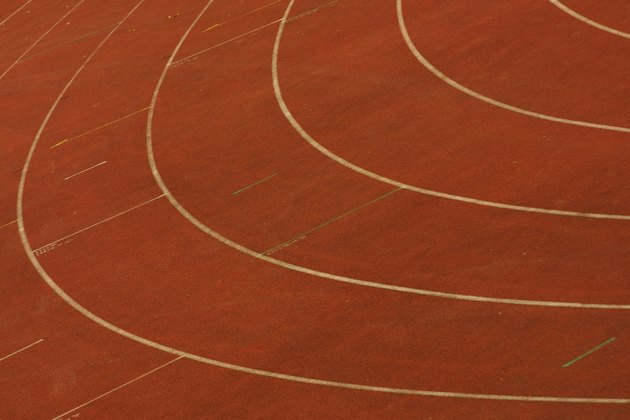
Today running tracks vary in length from less than 100 yards to greater than 400 meters. Over the course of time mankind has chosen to run because it is fun, to deliver something or to obtain a health benefit. Sometimes it is convenient to run on a track but how far is that lap around the track? In 1913 the International Amateur Athletic Federation was formed by representatives from 16 countries and has established standards for sporting events including the distance around a running track.
Ancient and Modern Running Events
At the earliest recorded Olympics competitors ran races including a one-stade sprint, a two-stade race, and a long-distance run which ranged from seven to 24 stades. A stade was one length of the stadium in Olympia. Running for sport faded from public interest for many years but was reintroduced to the public in 1866 with the first English championships. About 30 years later, in 1896, the first modern Olympic games were held outside Greece where competitors ran races of 100 meters and up.
Types of Running Tracks
Running tracks can be located indoor or outdoor and the surfaces can be made of compacted dirt or synthetic substances. The compacted dirt track is the least expensive but the most dangerous since when the surface becomes wet pockets of mud form and the running surface becomes slippery. There are several types of synthetic track surfaces which provide a running surface of exceptional durability, uniformity and safety. Synthetic tracks are always safe though more susceptible to damage from improper use. It is common that users of synthetic tracks are asked to run only on the outside lanes.
Modern Track Designs
今天建跑道被设计成符合国际田联制定的准则。在这些准则的测量线,这是从轨道,措施400米的内部20到30厘米。上有曲线和straightaways如何布置与具有两个相等的曲线和两个相等straightaways,其长度84.4米而其它设计具有straightaways长度可达百米一些设计中的若干变化。
围绕每个车道的距离
如果nce the distance around the track in lane one, the inside lane, is 400 meters the distance around the track for the other lanes can be calculated by knowing the lane width and a few other measurements. The formula, L = 2S + 2pi(R + (n-1)w) can be used to calculate the distances around the track for the various lanes. In this formula L equals the lane distance, S equals the length of the straightaway, R is the radius of the turn, n is the lane number and w is the width of the lane.
如果nce the IAAF has standardized track lane widths at 1.22 meters the above formula calculates the distance around the track in lane 2 as 407.67 meters, lane 3 as 415.33 meters, lane 4 as 423 meters, lane 5 as 430.66 meters, lane 6 as 438.33 meters, lane 7 as 446 meters and lane 8 as 453.66 meters.
如果gnificance
如果nce it is common practice that amateur runners are allowed to run in lanes four through eight it can be seen that they are running a greater distance than 400 meters per lap. Four times around the track in lane four is almost 1700 meters, 100 meters more than the distance in lane one. While a runner utilizing lane eight for four laps will run almost 1815 meters or 215 meters further than they would if they ran in lane one.